Look closerPlants
Tar spot: the black blotches on maple leaves
When: August to November
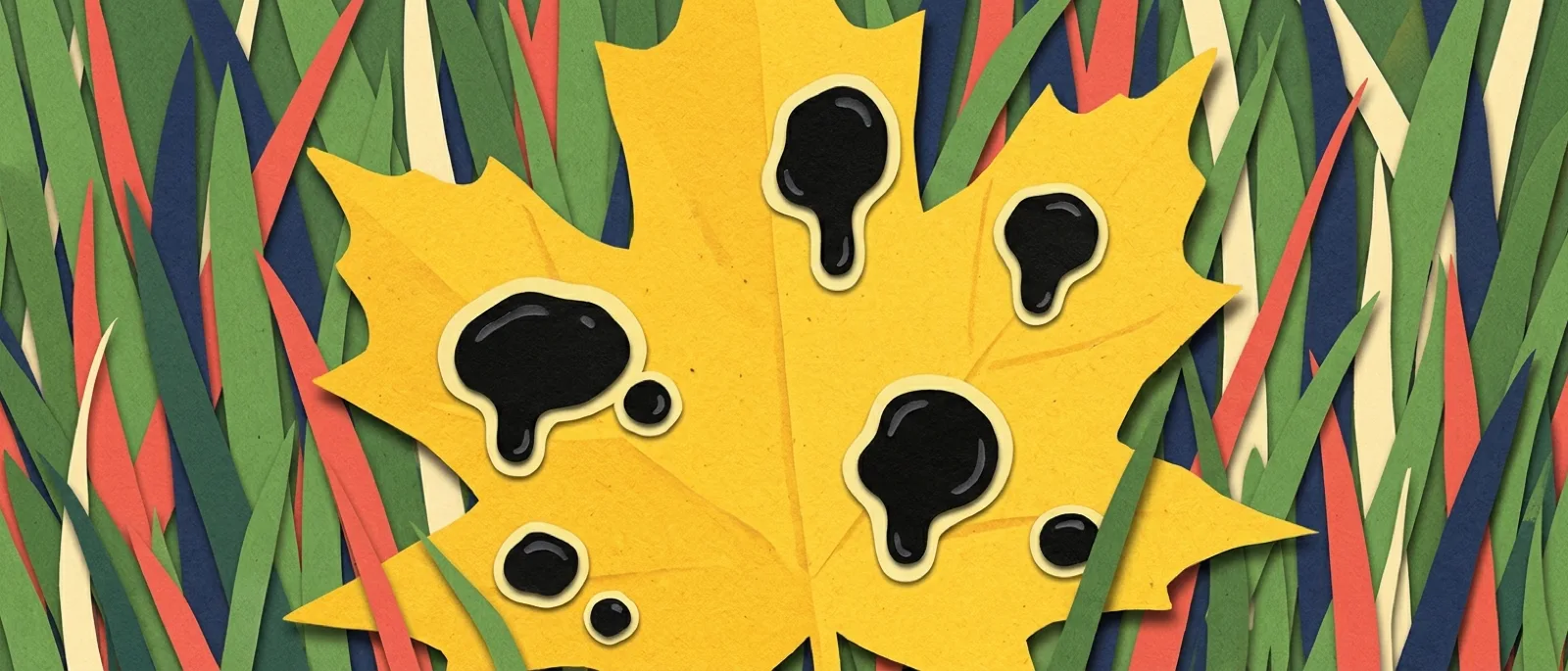
Tar spot is a fungus that leaves raised black blotches, like drips of tar, on maple leaves, biggest on Norway maples and smaller on red and silver maples. The spots darken over the summer and stay on the leaves after they fall, which is where the fungus spends the winter.
Why this time of year
The black spots fill in by late summer and stay on the leaves through fall leaf drop. On Norway maples, UMass Extension says serious outbreaks come roughly once a decade, so some years the spots are everywhere.
How to notice it
- Find a maple along a street, in a yard, or in a park, and look at the tops of its leaves, on the tree or on the ground below it.
- On a Norway maple, look for black blotches up to about an inch and a half across, sometimes with a yellow ring around them.
- On a red or silver maple, look for smaller black spots, about a quarter to half an inch across.
- Look down at the fallen leaves under the tree: they tend to land spots-up, ready to send out spores next spring when the new leaves open.
Try this with kids: Can you find a fallen maple leaf with a black spot bigger than your thumbnail?
Word to know: “Spores” are the tiny, dust-like cells a fungus uses the way a plant uses seeds.
Sources
- umass.eduUMass Extension fact sheet (Nicholas Brazee, updated September 9, 2026). Tar spot is caused by Rhytisma (R. acerinum, R. americanum, R. punctatum). Norway maple is the most common and most severely affected host ('giant tar spot'). Silver and red maple are regularly infected, usually with much smaller spots. Sugar and striped maple rare hosts; not known on Japanese maple. Symptoms first appear when leaves reach full size, 'late May to early June in Massachusetts', and merge into large black spots 'by late summer (typically in August)'. Overwinters on diseased foliage; spores released 'at or shortly after budbreak'. Shed leaves 'tend to land with the fruiting structures facing up, allowing for effective spore release the following spring'. 'Across southern New England, the most recent outbreak in 2026 was preceded by one in 2017.' Typically 'a minor aesthetic issue but is highly conspicuous'.
- homegarden.cahnr.uconn.eduUConn Home and Garden Education Center (2015, rev. 2019). Spots seen 'During late summer and into fall' against 'the lighter green or fall color of the leaves'. Spring infection from spores on the previous season's fallen leaves. Black spots develop 'In mid to late summer'. Sizes: R. punctatum about 1 mm; R. americanum 0.25-0.5 inch, raised; giant tar spot (R. acerinum) on Norway maple 1-1.5 inches, sometimes yellow border, 'common in the northeastern U.S.'. 'does not typically cause the host tree any harm'.
- rensselaer.cce.cornell.eduCornell Plant Disease Diagnostic Clinic fact sheet (via CCE Rensselaer). 'raised, black spots' that 'so closely resemble droplets of tar'; 'rarely serious enough to threaten the health of trees'; red and silver maple black spot 'by mid-July to early August'; Norway maple pinhead spots 'in late July or early August', merging; fungi 'overwinter on infected leaves that fall to the ground'; spores escape 'just as new leaves are unfolding'.
Checked against these sources on October 23, 2026.
In the guide for August, September, October, November