Look closerAmphibians
Red-backed salamanders under logs: salamanders that never go to water
When: October to November
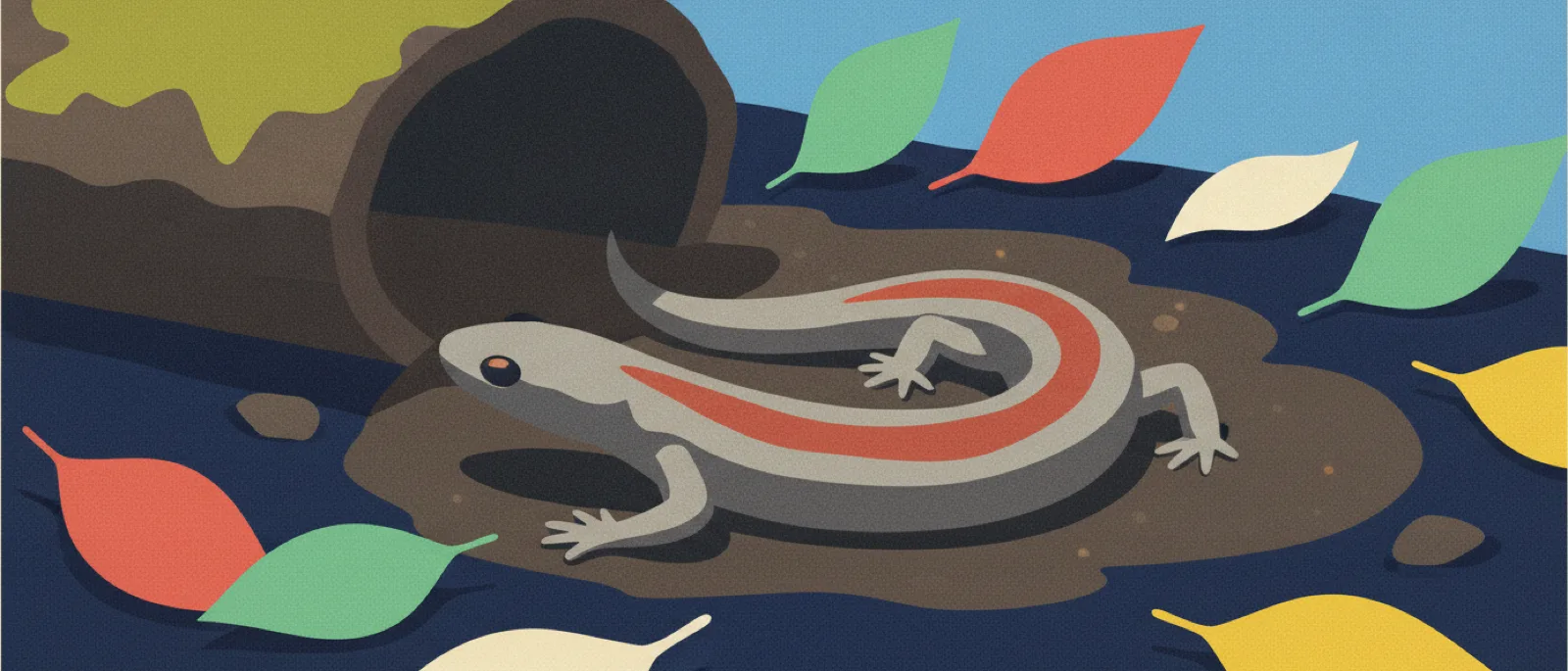
The eastern red-backed salamander is a finger-length grey salamander, usually with a rusty stripe down its back, and it lives its whole life on the forest floor under logs, rocks and leaf litter. It has no tadpole stage at all: it hatches out of an egg laid in a rotten log as a tiny land animal and never once goes to water.
Why this time of year
Autumn rain has soaked the leaf litter back to the damp these salamanders need and the ground has not frozen, so they are shallow and findable. The window closes around the middle of November, when they move down below the frost line.
How to notice it
- Pick a damp shady patch of hardwood woods a day or two after rain. Look for a fallen log or flat rock lying loose on top of the leaf litter, not one sunk into the soil or grown over.
- Crouch on one side and roll it slowly toward yourself, so the log stays between you and whatever is underneath. Slow matters, because a fast flip startles the animal into bolting before you see it.
- Look at the dirt, not the log. A red-back is about the length of your finger, grey with a straight rusty stripe from neck to tail. Some are solid slate grey with no stripe, and those are the same species.
- Do not touch it. Roll the log back into its exact groove, checking nothing is under the edge as it settles. Two or three logs is a visit.
Try this with kids: This salamander hatched from an egg in a rotten log and has never once been in water. Can you think of another woodland animal that could say that?
a forest salamander with no tadpole stage, hatching straight out of the egg as a tiny land animal
Safety
- Do not handle the salamander. Oils, salts and lotion on your skin can harm it, and it takes in air and water through that skin. If an adult must move one, clean wet hands only, and never hands that have touched insect repellent or sunscreen.
- Roll the log back exactly as you found it. Downed hardwood in eastern forests has a half-life of about ten years and can take many decades to break down fully, so a log soft enough to shelter a salamander has been becoming that log for a very long time.
- Never set the log down on top of the animal. Put the cover back in its groove first and let the salamander walk to it.
- Leave logs and rocks that are sunk, half buried or heavy. Only lift what is lying loose and what a child can move without straining.
- Wash hands afterwards and keep fingers away from mouth and eyes until you do.
Sources
- massaudubon.orgMass Audubon, Massachusetts: found across the state; the abundance claim in the hedged form the evidence supports, that this salamander MAY BE the most abundant vertebrate in the northeast; and the fully terrestrial life cycle that separates this from every other amphibian entry here, since unlike our other salamanders it spends its entire life on land, lays eggs on the moist forest floor, and the young skip the aquatic stage. Also the colour: often GREY with a red stripe, sometimes entirely red or entirely grey.
- nationalzoo.si.eduSmithsonian National Zoo and Conservation Biology Institute: flip the log TOWARDS you so it acts as a barrier between you and whatever lives under it; flip slowly so as not to startle anything; always put the rock or log back gently and exactly as you found it; and, plainly, do not handle the salamanders, because oils, salts and lotion on your skin can be harmful.
- dnr.maryland.govMaryland DNR herp ethics: lift the side farthest from you, which is the same motion the Smithsonian describes; return the cover object to its original position; place a released animal next to the cover after it is back rather than under it; wet hands if handling is necessary; keep amphibians away from insect repellent and sunscreen; and wash before touching mouth or eyes.
- usgs.govUSGS on Grant and colleagues, Biology Letters 2024: an average of about 5,300 red-backed salamanders in a patch of Northeast forest the size of a football field, with combined biomass similar to or greater than white-tailed deer. This is the modern defensible version of the abundance folklore.
- osti.govBurton and Likens 1975, Copeia, at Hubbard Brook, New Hampshire: about 2,950 salamanders per hectare, Plethodon cinereus about 93.5 percent of total salamander biomass, and salamander biomass about twice that of birds at the birds' peak breeding season. A BIOMASS claim at ONE forest, which is what the popular most-abundant-vertebrate line garbles.
- northernwoodlands.orgNorthern Woodlands: they resurface in autumn as rains replenish soil moisture, and BY MID-NOVEMBER the spaces beneath the boards were empty and the salamanders had gone down below the frost line. This is what closes the window.
- virginiaherpetologicalsociety.comVirginia Herpetological Society: a prolonged mating season from autumn to early spring; retreats under stones, in soil cavities and in rotting logs; eggs in moist cavities in leaf litter, soil burrows or rotting logs; no aquatic larval stage; and uniformly dark grey or black individuals occur.
- research.fs.usda.govRussell and colleagues 2014, Ecosystems, USDA Forest Service: residence times and decay rates of downed woody debris in eastern US forests, with a hardwood half-life averaging about 10 years and species-level average total residence times of 46 to 71 years. The half-life is the honest headline and the card uses it.
Checked against these sources on September 6, 2026.
In the guide for October, November