Right outsideSky
Earth's shadow and the Belt of Venus after sunset
When: All year
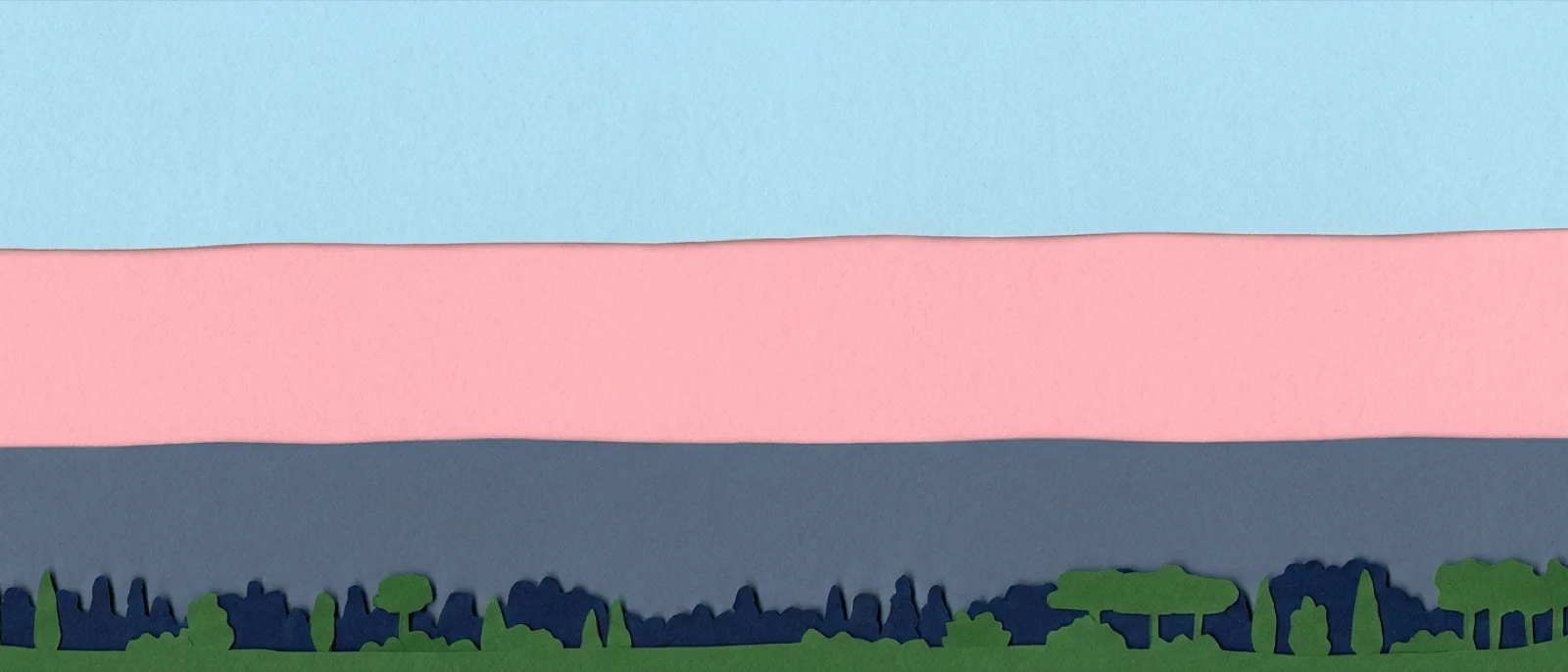
On a clear evening, turn your back to the sunset and look low in the eastern sky. The dark blue-gray band rising from the horizon is the shadow of the Earth itself, cast on the air, and the pink band above it is called the Belt of Venus.
Why this time of year
It needs no season: any clear evening with an open view toward the east can show it, starting a few minutes after sunset. Before sunrise the same pair shows in the west, sinking instead of rising.
How to notice it
- Around sunset on a clear evening, go where the view toward the east is low and open (a field, a beach, a hilltop, a big parking lot). Stand with the sunset behind you.
- In the first few minutes after sunset, look low along the eastern horizon for a thin dark blue-gray band, with a pink glow above it.
- Keep watching for 10 to 20 minutes: the dark band thickens and climbs while the pink fades, until the edge blends into the darkening sky.
- Early riser? Before sunrise, face west and watch the same dark band sink toward the horizon.
Try this with kids: Stand with the sunset at your back and point to where the dark band meets the pink. Check again in five minutes: did the dark band climb higher?
Phrase to know: “Belt of Venus”: the pink band just above Earth's shadow, sky still lit by reddened sunlight scattered back toward you.
Sources
- atoptics.co.ukAtmospheric Optics (Les Cowley), a permanent reference page, read 2026-11-06. It says 'After sunset look eastwards' and 'Look westwards before sunrise to watch the shadow sinking towards the horizon'. It names the pink band 'immediately above' the shadow as the Belt of Venus / anti-twilight arch, lit by 'scattered and deeply reddened sunlight'. It says 'A low horizon is needed' and warns against a high horizon 'such as mountains or buildings'. It gives no minutes. (The older address atoptics.co.uk/atoptics/earshad.htm 301-redirects here; the quoted lines are on the redirected page, last updated December 16, 2024.)
- cloudatlas.wmo.intWMO International Cloud Atlas, primary and permanent, read 2026-11-06. It says 'The Earth's shadow gradually rises above the horizon opposite the Sun after sunset' and that it appears 'dark blue-grey and sometimes with a violet tinge'. The twilight arch is 'a rose violet ribbon bordering the upper edge of the shadow'. No minutes or season limits.
- cloudatlas.wmo.intWMO Cloud Atlas image 4793 (Claudia Hinz), read 2026-11-06. An evening-twilight panorama dated 06 March 2012 at 17:40 local time, camera toward ESE. The caption says the shadow 'has a distinct blue-grey colour and is rising above the horizon as the Sun lowers', and names the ribbon above it 'the anti-twilight arch, also known as the "Belt of Venus"'.
- astroleague.orgAstronomical League observing sheet 'Alpenglow, Belt of Venus, and Earth's Shadow' (c) 2024, a one-page PDF read 2026-11-06. It is the source for the timing. Belt of Venus 'Becomes apparent 5 minutes before sunset until 10 minutes after sunset'. Shadow: 'Begin looking very low in the East opposite the sun 2-3 minutes after sunset'. 'By ten minutes after sunset, it has thickened, with its leading edge reaching 10 degrees above the horizon', and its edge 'nearly matches that of the darkening sky'.
- skyatnightmagazine.comBBC Sky at Night Magazine (Katrin Raynor, 2022-04-17), secondary, read 2026-11-06. It says 'When the Sun is setting in the west, look east to see the Belt, which is visible about 10-20 degrees above the horizon'. The Belt 'may be visible from a few minutes up to 20 minutes'. All you need is 'a clear sky, shortly before sunrise or after sunset, and an unobstructed horizon'.
- colorado.eduUniversity of Colorado column by Prof. Jeff Mitton (Ecology and Evolutionary Biology), dated 2016-03-24/25, read 2026-11-06. It says 'Immediately after the sun drops below the horizon in the west, a deep blue line forms on the eastern horizon', and 'Just before dawn, the shadow of the earth shrinks to the horizon in the west'. It names the Belt of Venus 'immediately above the shadow of the earth', seen 'When the air is clear and clouds do not occlude the sky'.
- earthsky.orgEarthSky (Deborah Byrd), a dated Tonight post from 2020-10-27, read 2026-11-06. It is not a permanent page, and the permanent pages above carry every claim without it. It says 'It can be seen any clear evening, ascending in the eastern sky' and 'The pink band above the shadow - in the east after sunset, or west before dawn - is called the Belt of Venus'. It also says the shadow can be seen from cities.
- earthsky.orgEarthSky (Bruce McClure), a dated Tonight post from 2020-11-27, read 2026-11-06. It is not permanent and is cited only for the timing conflict. It says 'looking opposite the sunset direction, roughly 30 to 60 minutes after sunset' and 'You might see it around 30 to 45 minutes after sunset'. It also says 'An unobstructed horizon and clear sky will increase your chances'.
- science.nasa.govNASA APOD 2010-07-29 'Sunset, Shadowrise' (the apod.nasa.gov/apod/ap100729.html redirect), primary, read 2026-11-06. It says 'Behind Uluru is the shadow of planet Earth itself, a dark blue arch rising in the east', with the pinkish Belt of Venus above it. The panorama is dated May 28. It is a dated example, not a timing source.
- science.nasa.govNASA APOD 2005-01-27 'Shadow Set', read 2026-11-06. Before sunrise in January (Mt. Jelm, Wyoming), Earth's shadow sets in the west as a dark blue band topped by the pink Belt of Venus. It supports the dawn-in-the-west version and a winter example. The page calls the shadow set 'a daily apparition', which with the 2003 page is the best year-round support.
- science.nasa.govNASA APOD 2003-08-22 'Shadow Rise', read 2026-11-06. An August evening view facing east shows Earth's shadow as a dark blue band along the horizon, with the antitwilight arch / Belt of Venus above it, lit by reddened light from the setting Sun. It is a summer example. The page calls it 'this daily apparition'.
- britastro.orgBritish Astronomical Association Journal (Giovanni di Giovanni, 2025-02-07; observations in central Italy 2020-2024), read 2026-11-06. It says bands 'appear about 10 minutes after sunset (or before sunrise)' and that the shadow 'disappears after about 30 minutes'. From the extract it is unclear whether the 30 minutes runs from sunset or from first sight. Details are evident 'When the sky is clear and cloudless'.
Checked against these sources on November 6, 2026.