Listen forBirds
The Barred Owl's who-cooks-for-you call
When: September to May
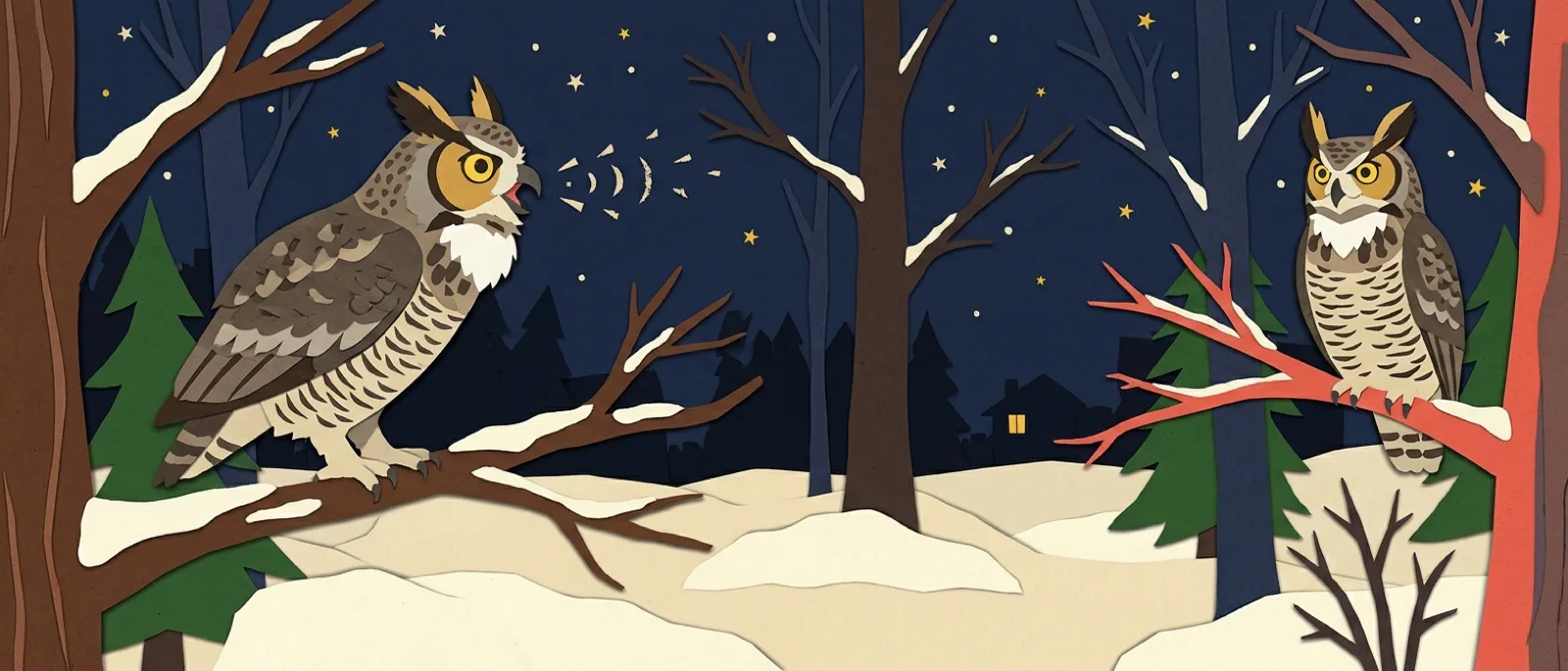
The Barred Owl's hoot is a run of 8 to 9 notes that people hear as 'Who cooks for you? Who cooks for you-all?' Barred Owls live in Massachusetts year-round, and Mass Audubon says they can be heard calling year-round.
Why this time of year
Barred Owls do not migrate, and Mass Audubon says their hooting intensifies as the breeding season approaches. They are found in most of Massachusetts other than the Islands. Mass Audubon's breeding bird atlas calls them fairly widespread and strongly increasing, with new arrivals on Cape Cod, and in the east they keep mostly to wet forests dominated by Red Maple.
How to notice it
- After dark, step outside and listen toward the nearest woods, best of all wet woods near a swamp. Skip windy nights, and leave the flashlight off unless you need it, since light can scare owls off.
- Listen for a deep, barking run of hoots: hoo, hoo, hoo-hoo; hoo, hoo; hoo, hooo-aw. From far away it can sound like a large dog.
- Keep your ears open by day too. Barred Owls sometimes call in daylight.
- Now and then Barred Owls break into what Mass Audubon calls a fervent caterwauling, a series of wild hoots and screams.
Try this with kids: When you hear the owl, count its hoots on your fingers. Did you get 8 or 9?
Sources
- massaudubon.orgMass Audubon, Owls of Massachusetts (primary, state naturalist org; fetched 2026-11-10). Range, year-round calling (basis for every month 1-12, including December), mnemonic, dayparts: 'Barred Owls Can be found in most of Massachusetts other than the Islands, and can be heard calling year-round - listen for who cooks for you, who cooks for you all?' 'Most species are especially vocal just after sunset and then again just before sunrise.' 'Some species, such as the Eastern Screech Owl and Barred Owl, will vocalize during the day too.'
- massaudubon.orgMass Audubon Breeding Bird Atlas 1 species account, Barred Owl (Atlas 1 data 1975-1979; primary). Year-round residence and calling, peak, caterwauling, egg dates, wet-woods habitat: 'Egg Dates February 25 to May 13'. 'Barred Owls in Massachusetts are year-round residents'. 'the Barred Owl can be heard throughout the year, but, as the breeding season approaches, it intensifies its familiar nine-note serenade'. 'sometimes partake in a fervent caterwauling, a series of wild, almost maniacal, hoots and screams'. 'especially in woodlands near extensive swamps, reservoirs, and Beaver ponds'. Also: 'At this time, the adults are surprisingly quiet' (summer, with young). Atlas 1 range: 'extremely rare on Cape Cod and the Islands'; 'absent on Cape Cod and the Islands'. Summer (quote confirmed by the refute pass): 'The young remain with the adults for most of the summer, begging for food and learning to hunt. At this time, the adults are surprisingly quiet.'
- massaudubon.orgMass Audubon Breeding Bird Atlas 2 species account, Barred Owl (primary). Status: 'Fairly widespread and strongly increasing'. Mnemonic and habitat: 'who cooks for you, who cooks for you all?' 'its deep, resonant voice carries well in the moist forested woodlands'. East and Cape: Atlas 1 'the species became progressively less widespread farther east'; Atlas 2 'made new incursions into Barnstable County, including invading the Upper Cape'; 'Growth was slowest in the Bristol/Narragansett Lowlands'. Atlas 2 ecoregion table, % of blocks with Barred Owl: Boston Basin 12.5%, Bristol and Narragansett Lowlands 14.9%, Cape Cod and Islands 3.5% (5 blocks), S. New England Coastal Plains and Hills 47.7%, Worcester Plateau 83.0%, statewide 42.4% (440 blocks). East (quote confirmed by the refute pass 2026-11-10): 'mostly in areas of wet forests dominated by Red Maple'.
- massaudubon.orgMass Audubon, 'Owling 101: How to Spot an Owl', dated February 07, 2024 (primary org article). Day calling and range, windy nights, flashlight, duet gloss: 'Barred Owls, found in most of Massachusetts other than the southeast, will call during the day with their famous refrain of "Who cooks for you?"' 'Steer clear of windy nights because it can be hard to hear'. 'avoid using a flashlight unless you need it since they can scare off the owls.' 'If they duet (two owls calling to one another)' (said of Great Horned Owls; used only for the gloss definition).
- web.archive.orgCornell Lab, All About Birds, Sounds (archive snapshot 2026-08-12; live site 403). Note count and duet: 'Barred Owls have a distinctive hooting call of 8-9 notes, described as "Who cooks for you? Who cooks for you-all?"' 'During courtship, mated pairs perform a riotous duet of cackles, hoots, caws and gurgles.'
- web.archive.orgCornell Lab, All About Birds, Overview (archive snapshot 2026-05-26). 'a classic sound of old forests and treed swamps.' 'the species' barking "Who cooks for you?" call. At great distance, this can sound like a large dog.' 'Barred Owls don't migrate, and they don't even move around very much.'
- web.archive.orgCornell Lab, All About Birds, Life History (archive snapshot 2026-01-22). 'Barred Owls live year-round in mixed forests of large trees, often near water.' 'Territorial all year round, they chase away intruders while hooting loudly.'
- audubon.orgNational Audubon field guide (secondary reference). Hoot pattern and day calling: 'A loud barking hoo, hoo, hoo-hoo; hoo, hoo; hoo, hooo-aw!' 'Although the bird is mostly active at night, it will also call and even hunt in the daytime.' 'The Barred Owl is a permanent resident throughout its range'. 'Members of pair often call in duet.'
- web.archive.orgUS Fish and Wildlife Service story, Feb 6, 2024, about Minnesota Valley NWR (federal, but NOT Massachusetts; supporting only). 'Courtship during this month [February] is more commonly when duetting pairs would be heard, but barred owl calls can be heard year-round.' Not used for any reader-facing Massachusetts claim.
Checked against these sources on November 10, 2026.
In the guide for September, October, November, December, January, February, March, April, May