Right outsideBirds
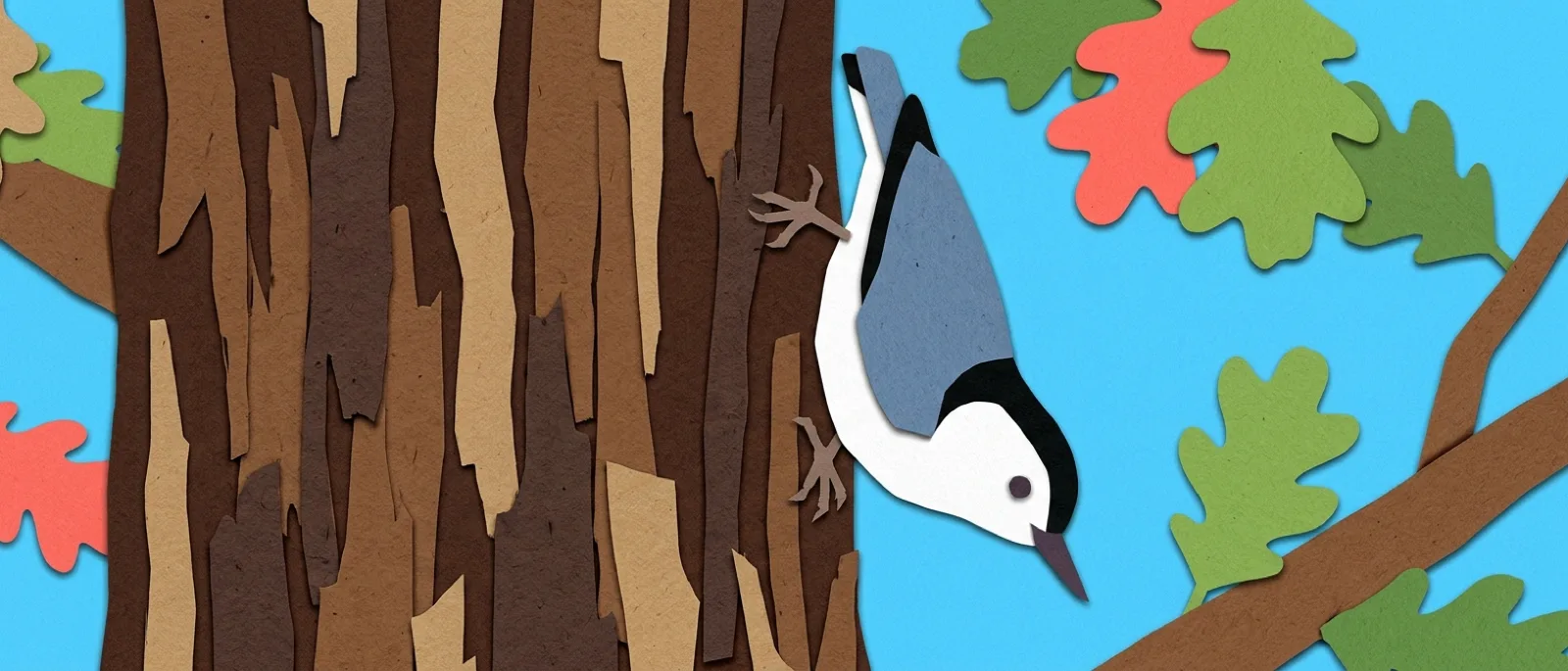
White-breasted nuthatch: the bird that climbs down trees headfirst
When: All year
The white-breasted nuthatch is a small gray-and-white bird that climbs down tree trunks headfirst, and it also creeps sideways and hangs upside down under branches. Woodpeckers and brown creepers can't do this, because they prop themselves up on their tails.
Why this time of year
White-breasted nuthatches stay in eastern Massachusetts all year, so any day with bare or leafy trees is a good day to catch one coming down a trunk. In fall and winter they push seeds into bark cracks, and their nasal calls carry through the woods on cold mornings.
How to notice it
- Look at the trunk of a big tree, or a tree near a bird feeder, and watch for a small gray-backed bird with a white face and a black or dark gray cap.
- Check which way it faces as it moves: a nuthatch often comes down with its head pointing at the ground, and may sidle around the trunk or hang under a branch.
- Listen for a short, nasal 'yank-yank', which often gives the bird away before you see it.
- If it takes a seed from a feeder, follow it to a nearby tree and watch whether it jams the seed into the bark and whacks it with its bill.
Try this with kids: Find a bird on a tree trunk. Is its head pointing up at the sky or down at the ground? If it's down, you found a nuthatch!
Sources
- massaudubon.orgMass Audubon (primary, regional): among birds that crawl on trunks, 'only the curious little nuthatches descend trees head-first'. The name 'nuthatch' comes from wedging a seed into a bark crevice or branch crotch and using the bill to 'hatchet' the 'nut' open. Gives the 'distinctive nasal yank yank call'. Says the species is 'increasing in all seasons and can be found across the Commonwealth', which shows Massachusetts presence in every season. Also says at feeders they tend to take one seed at a time and carry it to a nearby spot.
- audubon.orgNational Audubon field guide (primary): call 'A nasal yank-yank'. Its nasal calls are 'typical and familiar sounds of winter mornings in deciduous woods'. 'Usually a permanent resident', with occasional southward movements only in western and northern parts of the range. 'During fall and winter, regularly caches food items in bark crevices on territory.' This page does NOT describe the headfirst descent.
- maineaudubon.orgMaine Audubon, Backyard Bird of the Month (primary, neighboring New England state): 'They often descend tree trunks head-first, unlike woodpeckers, and will hang upside down on branches to search for insects.' Also: they 'wedge large nuts like acorns into bark crevices and hammer them open with their beaks; this is where the name nuthatch comes from.'
- birdweb.orgBirdWeb, Birds Connect Seattle (formerly Seattle Audubon), nuthatch family page (secondary, Audubon chapter): 'They do not use their tails to prop themselves up like woodpeckers and creepers'. Their strong toes and claws let them 'climb up, down, and sideways on tree trunks and branches'. This is the tail-brace contrast with woodpeckers and creepers.
- tn.govTennessee Wildlife Resources Agency (primary, state wildlife agency): they 'creep both up and headfirst down tree trunks while foraging'. They store food by 'jamming them into tree bark and hammering or 'hatch' the food open with their bills'. 'A year-round resident throughout its range.'
- fws.govUSFWS checklist for Great Meadows, Assabet River and Oxbow refuges, eastern Massachusetts (May 2010, refute pass): White-breasted Nuthatch 'c c c c', common in spring, summer, fall and winter, and marked as nesting. Local basis for months 1-12.
Checked against these sources on October 23, 2026.