Right outsideWeather
Why the first ice forms in puddles and buckets before ponds
When: October to November
The first ice of the season turns up in puddles, birdbaths, buckets and dog bowls, and along the shallow edges of a pond, while the middle of that same pond stays open for weeks yet. A shallow skin of water has almost no stored heat to give up on a cold night; the deep part is still working off the heat it took in all summer.
Why this time of year
October and November are when this region starts collecting the clear calm nights that cool the ground hardest, and the National Weather Service runs its eastern Massachusetts frost and freeze season to around the median date of the first autumn freeze in mid October. Early enough to ice a bucket, far too early to ice a pond through.
How to notice it
- Go out at first light after a clear calm cold night. Frost weather is patchy and varies a lot across a small area, so check several spots.
- Check the small water first: a puddle in the driveway, a birdbath, an open bucket, a sagging tarp, a bowl left on the steps. Look for a skin thin enough to read the leaves through.
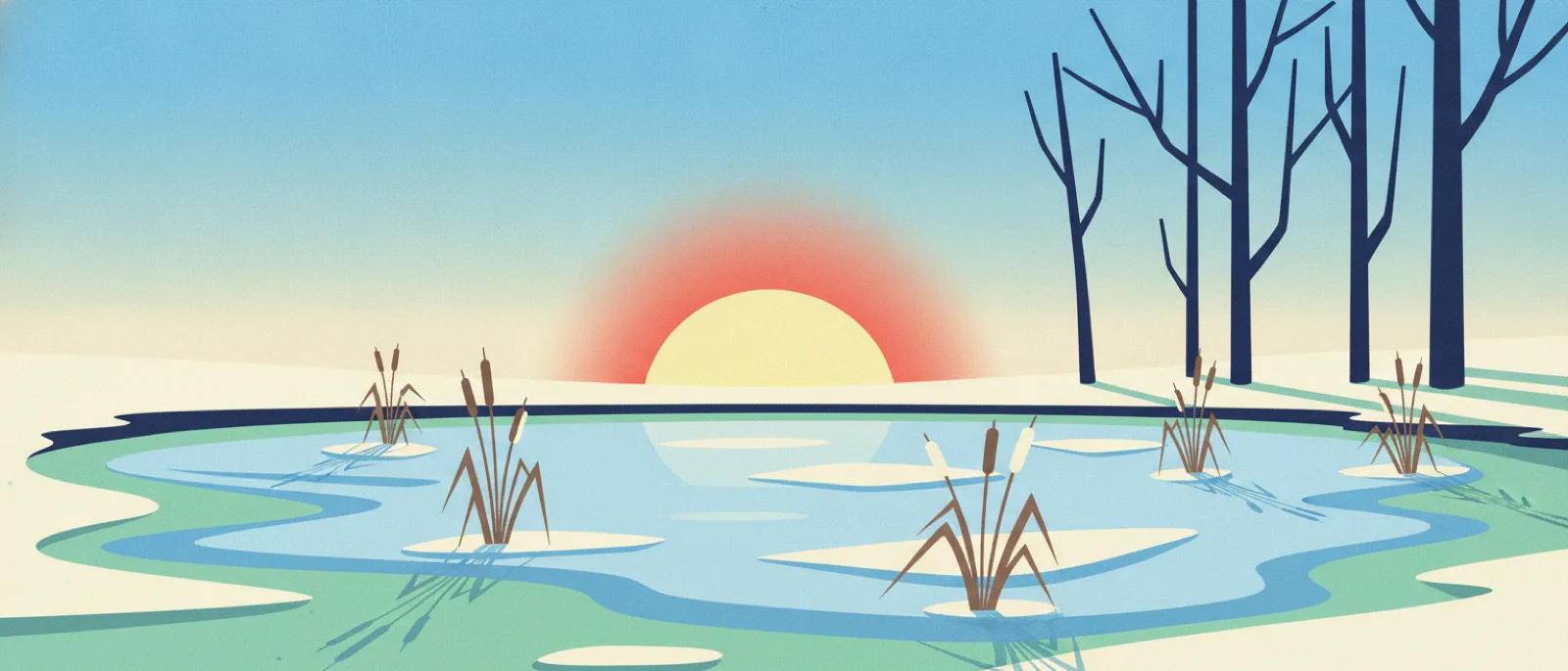
- Then look at a pond from solid ground. The shallow edge may have skinned over on the same morning while the middle is wide open, sometimes steaming. That gap across one pond is the whole point.
- Over several cold mornings, note which containers ice first. The shallowest ones open to the sky win and the deeper or sheltered ones hold out.
Try this with kids: Find two waters this morning, one you could pick up and one you could not. Which has ice on it, and how many mornings do you think the big one needs to catch up?
a puddle holds almost no stored heat, so it freezes on a night that barely dents a pond
Safety
- Edge ice is the hazard this card walks toward. A pond can have ice at its edge on the same morning as your bucket, and it will not hold anything. Never step on, tap or test ice over a pond, stream, marsh or ditch at any point in the season, and look only from solid ground.
- Ice on a puddle means ice on the pavement, stairs and boardwalks nearby. Watch footing while you are watching the water.
- Leave other people's water alone, and do not break ice with your hands. Thin ice has edges.
Sources
- seagrant.umn.eduMinnesota Sea Grant, and the source that forced this entry's central correction: lake ice freezes first at the surface STARTING AT THE EDGES OR SHORELINE, because water near the shore is typically shallower and contains less heat than deeper water so it can reach the freezing point faster. Also names temperature and turbulence as the two controls, which is why a still bucket ices before wind-stirred open water.
- usgs.govUSGS: water must absorb 4,184 joules for one kilogram to rise one degree C, against 385 for copper, so water stores an unusual amount of heat and is slow to change temperature. The volume of water, not just the cold air, sets the timetable.
- wxguys.ssec.wisc.eduUniversity of Wisconsin Space Science and Engineering Center: shallower lakes usually freeze before deeper lakes since they contain less water that needs to be cooled, and a body that warmed more over the summer takes longer because the entire lake, not just the surface, must cool. NOTE this is Madison, Wisconsin, and is the only quantitative freeze-timing evidence in the entry, standing in for a different climate.
- weather.govNWS Boston frost and freeze programme, the local timing anchor: the eastern Massachusetts, Rhode Island, northern Connecticut, Cape and Islands zone runs to October 11, roughly aligned with the median first freeze at 32F or lower, and frost is a localised phenomenon that can vary greatly across a small area. Note the document is a 2024 edition.
- forecast.weather.govNWS glossary: frost is the formation of thin ice crystals on the ground or other surfaces in the form of scales, needles, feathers or fans. This establishes that frost is deposition onto a surface, a different state and route than standing liquid water freezing, which is what separates this entry from first-frost-reveals.
- usgs.govUSGS applying heat capacity to a pond: its temperature stays relatively the same from day to night. Note this argues DAY-TO-NIGHT stability rather than seasonal heat storage, so the seasonal claim rests on the Wisconsin source.
Checked against these sources on September 6, 2026.
In the guide for October, November